Learning in the AI era: the series map
12 reflections on learning, human judgment and systemic transformation in the AI era. The complete index of the series.
July 27, 2026 · Xavi Pascual · 3 min read
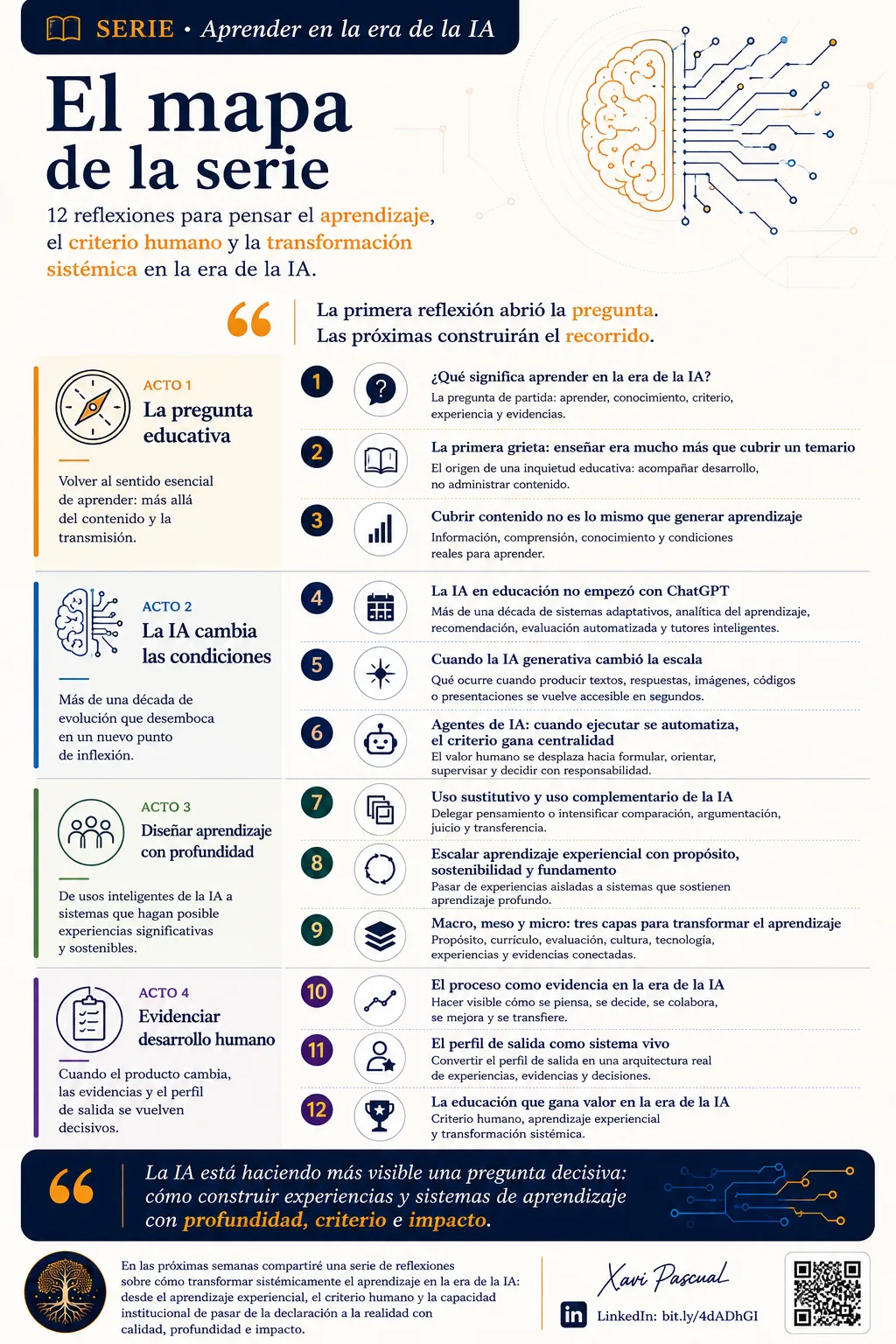
AI is making a decisive question more visible: how to build learning experiences and systems with depth, judgment and impact.
This series explores that question through 12 reflections organised in four acts: from the essential meaning of learning, to the change of conditions AI introduces, to designing learning with depth and, finally, to how we evidence real human development.
Act 1 · The educational question
Returning to the essential meaning of learning: beyond content and transmission.
- What does learning mean in the AI era? — The starting question: learning, knowledge, judgment, experience and evidence.
- The first crack: teaching was always much more than covering a syllabus — The origin of an educational unease: accompanying development, not administering content.
- Covering content is not the same as generating learning — Information, understanding, knowledge and the real conditions for learning.
Act 2 · AI changes the conditions
More than a decade of evolution leading to a new inflection point.
- AI in education did not start with ChatGPT — Over a decade of adaptive systems, learning analytics, recommendation, automated assessment and intelligent tutors.
- When generative AI changed the scale — What happens when producing texts, answers, images, code or presentations becomes accessible in seconds.
- AI agents: when execution is automated, judgment becomes central — Human value shifts towards framing, guiding, supervising and deciding with responsibility.
Act 3 · Designing learning with depth
From intelligent uses of AI to systems that make meaningful, sustainable experiences possible.
- Substitutive AI or expansive AI — Delegating thinking or intensifying comparison, argumentation, judgment and transfer.
- Scaling experiential learning with purpose, sustainability and foundations — Moving from isolated experiences to systems that sustain deep learning.
- Macro, meso and micro: three layers to transform learning — Purpose, curriculum, assessment, culture, technology, experiences and evidence connected.
Act 4 · Evidencing human development
When the product changes, evidence and the graduate profile become decisive.
- Process as evidence in the AI era — Making visible how people think, decide, collaborate, improve and transfer.
- The graduate profile as a living system — Turning the graduate profile into a real architecture of experiences, evidence and decisions.
- The education that gains value in the AI era — Human judgment, experiential learning and systemic transformation.
The underlying question
The point is not adding AI to what we already do. The point is transforming how we understand, design, accompany and evidence learning to form people capable of thinking, deciding, collaborating and acting with judgment.
This series was originally published as infographics on LinkedIn (in Spanish). Join the conversation on the launch post or follow me on LinkedIn.
Keep exploring
Related articles
University in the AI era
Challenger universities: not every university of the future will be a transformed university
Some universities don't need to transform because they were born different. What challenger universities are, what defines them, and what a traditional university can learn from them.
University in the AI era
University Learning Architecture: a framework for the AI era
Purpose → educational model → graduate profile → curriculum → experiences → assessment → evidence → impact. A macro–meso–micro framework to transform universities.
University in the AI era
Substitutive AI or expansive AI
The difference lies in whether the experience reduces or expands understanding, judgment and transferable learning. The same tool can produce opposite educational effects.
Shall we work on this together?
If this topic touches your institution, write to me. I reply personally, usually within 24 working hours.