Process as evidence in the AI era
When producing becomes more accessible, the real educational value lies in making visible how learning is built: how people think, decide, collaborate, improve and transfer.
July 6, 2026 · Xavi Pascual · 2 min read
Series Learning in the AI era · Reflection 10 of 12 · Series map
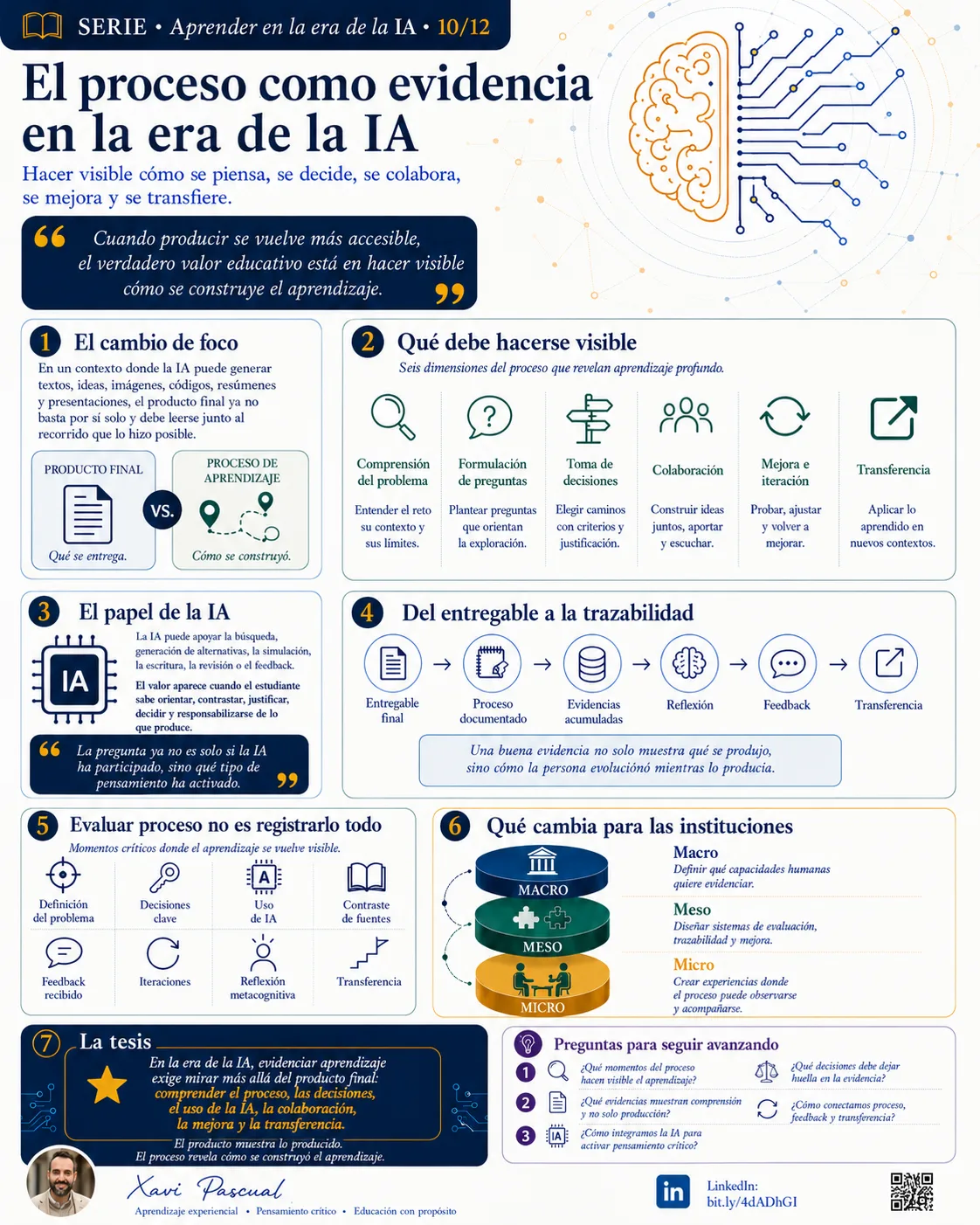
When producing becomes more accessible, the real educational value lies in making visible how learning is built.
The shift of focus
In a context where AI can generate texts, ideas, images, code, summaries and presentations, the final product is no longer enough on its own and must be read alongside the journey that made it possible.
Final product (what is submitted) vs. learning process (how it was built).
What must be made visible
Six dimensions of the process that reveal deep learning:
- Understanding the problem — grasping the challenge, its context and its limits.
- Formulating questions — posing questions that guide exploration.
- Decision-making — choosing paths with criteria and justification.
- Collaboration — building ideas together, contributing and listening.
- Improvement and iteration — testing, adjusting and improving again.
- Transfer — applying what was learned in new contexts.
The role of AI
AI can support search, generation of alternatives, simulation, writing, revision and feedback. Value appears when the student knows how to orient, contrast, justify, decide and take responsibility for what they produce.
The question is no longer just whether AI participated, but what kind of thinking it activated.
From the deliverable to traceability
Final deliverable → documented process → accumulated evidence → reflection → feedback → transfer.
Good evidence does not only show what was produced, but how the person evolved while producing it.
Assessing process is not recording everything
There are critical moments where learning becomes visible: problem definition, key decisions, use of AI, contrasting sources, feedback received, iterations, metacognitive reflection, transfer. Assessing process means capturing those moments, not surveilling every step.
What changes for institutions
- Macro — defining which human capabilities it wants to evidence.
- Meso — designing systems for assessment, traceability and improvement.
- Micro — creating experiences where the process can be observed and accompanied.
The thesis
In the AI era, evidencing learning demands looking beyond the final product: understanding the process, the decisions, the use of AI, the collaboration, the improvement and the transfer. The product shows what was produced. The process reveals how learning was built.
Next reflection → The graduate profile as a living system
This reflection was originally published as an infographic on LinkedIn (in Spanish). Join the conversation on the original post or follow me on LinkedIn for the next reflections.
Learning in the AI era
See the series map →Keep exploring
Related articles
Assessment & evidence
The final product is dead as evidence of learning
When any essay can be generated with AI, assessment must migrate from product to process: reasoning, decisions, iterations and defence of knowledge.
AI strategy & governance
Designing new interdisciplinary and transdisciplinary degrees: start with the profile, not the subjects
Most new degrees are designed by adding up courses from existing departments. How to design from the graduate profile and the problem the degree answers, and which organisational tensions must be resolved for it to survive.
Experiential learning
From peripheral experiential learning to the core of the educational model
Most institutions keep experiential learning at the margins: a project week, an annual challenge, an elective. What changes — across the three layers — when it becomes a structural part of the curriculum.
Shall we work on this together?
If this topic touches your institution, write to me. I reply personally, usually within 24 working hours.