What does learning mean when producing answers is no longer the hard part?
AI does not eliminate the need to learn: it makes visible that producing with help does not equal learning with depth. Six principles on how students learn.
May 4, 2026 · Xavi Pascual · 2 min read
Series Learning in the AI era · Reflection 1 of 12 · Series map
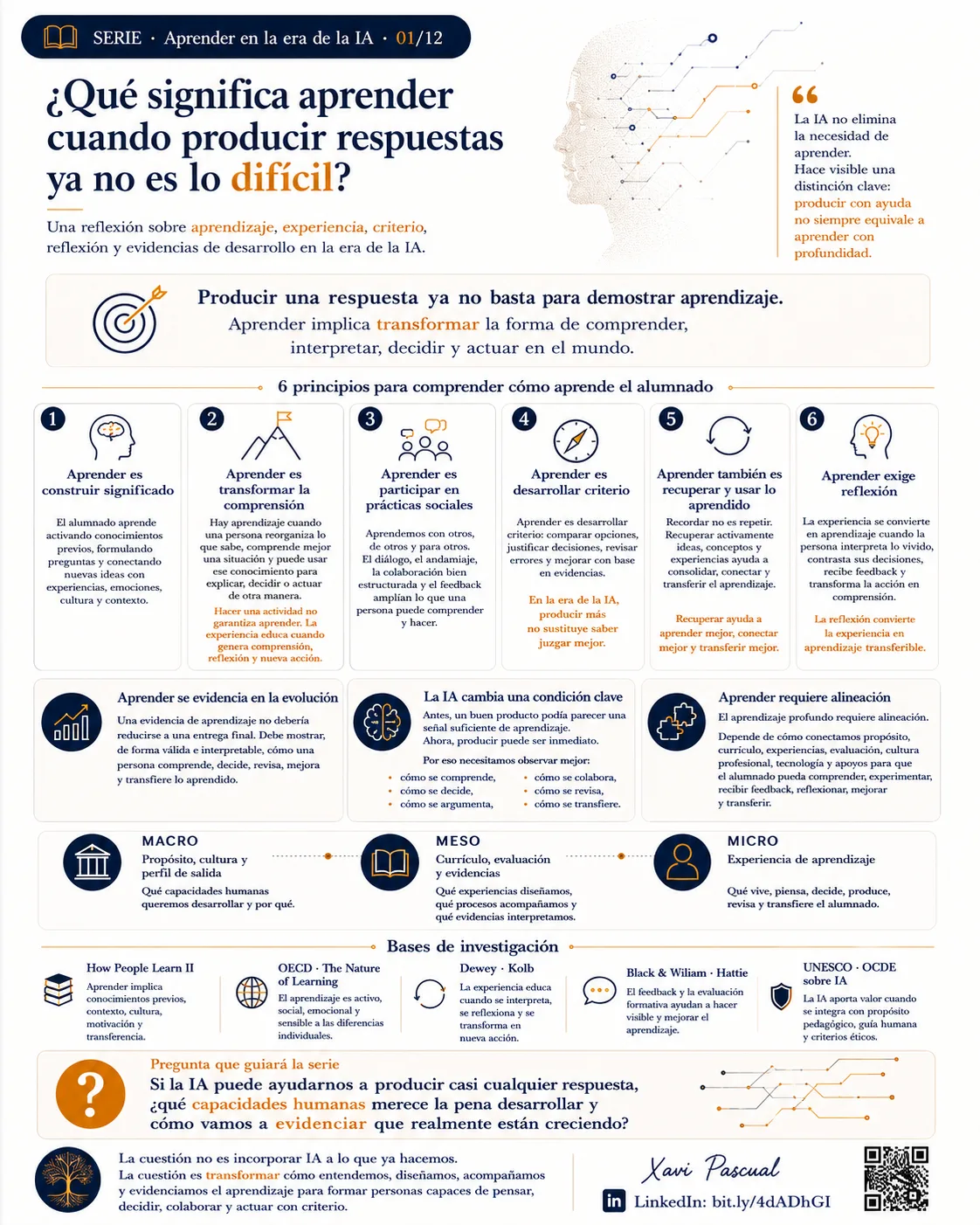
Producing an answer is no longer enough to demonstrate learning. Learning means transforming the way we understand, interpret, decide and act in the world.
AI does not eliminate the need to learn. It makes a key distinction visible: producing with help does not always equal learning with depth.
Six principles for understanding how students learn
-
Learning is constructing meaning. Students learn by activating prior knowledge, formulating questions and connecting new ideas with experiences, emotions, culture and context.
-
Learning is transforming understanding. Learning happens when a person reorganises what they know, understands a situation better and can use that knowledge to explain, decide or act differently. Doing an activity does not guarantee learning: experience educates when it generates understanding, reflection and new action.
-
Learning is participating in social practices. We learn with others, from others and for others. Dialogue, scaffolding, well-structured collaboration and feedback expand what a person can understand and do.
-
Learning is developing judgment. Comparing options, justifying decisions, reviewing errors and improving based on evidence. In the AI era, producing more does not replace judging better.
-
Learning is also retrieving and using what was learned. Remembering is not repeating. Actively retrieving ideas, concepts and experiences helps consolidate, connect and transfer learning.
-
Learning demands reflection. Experience becomes learning when the person interprets what they lived, contrasts their decisions, receives feedback and transforms action into understanding.
What changes with AI
Before, a good product could seem a sufficient signal of learning. Now, producing can be immediate. That is why we need to observe better how people understand, decide, argue, collaborate, review and transfer.
Evidence of learning should not be reduced to a final submission. It must show, in a valid and interpretable way, how a person understands, decides, reviews, improves and transfers what they have learned.
Three connected layers
- Macro — purpose, culture and graduate profile: which human capabilities we want to develop and why.
- Meso — curriculum, assessment and evidence: which experiences we design, which processes we accompany and which evidence we interpret.
- Micro — the learning experience: what students live, think, decide, produce, review and transfer.
This reflection draws on How People Learn II, OECD — The Nature of Learning, Dewey and Kolb, Black & Wiliam and Hattie, and UNESCO/OECD guidance on AI.
The question guiding the series
If AI can help us produce almost any answer, which human capabilities are worth developing, and how will we evidence that they are actually growing?
Next reflection → The first crack: teaching was always much more than covering a syllabus
This reflection was originally published as an infographic on LinkedIn (in Spanish). Join the conversation on the original post or follow me on LinkedIn for the next reflections.
Learning in the AI era
See the series map →Keep exploring
Related articles
Experiential learning
From peripheral experiential learning to the core of the educational model
Most institutions keep experiential learning at the margins: a project week, an annual challenge, an elective. What changes — across the three layers — when it becomes a structural part of the curriculum.
AI strategy & governance
Designing new interdisciplinary and transdisciplinary degrees: start with the profile, not the subjects
Most new degrees are designed by adding up courses from existing departments. How to design from the graduate profile and the problem the degree answers, and which organisational tensions must be resolved for it to survive.
Education M&A
A new educational reality demands a new M&A paradigm
Education M&A still runs on the playbook of any other industry: EBITDA multiples, synergies, financial due diligence. But the asset being bought — an educational project — is mutating. What academic due diligence is, why demographics and AI break the classic playbook, and how to buy learning architectures instead of cash flows.
Shall we work on this together?
If this topic touches your institution, write to me. I reply personally, usually within 24 working hours.