The education that gains value in the AI era
The more capabilities AI amplifies, the more value an education gains when it can develop judgment, autonomy, purpose and the capacity to transform reality. The synthesis of the series.
July 20, 2026 · Xavi Pascual · 3 min read
Series Learning in the AI era · Reflection 12 of 12 · Series map
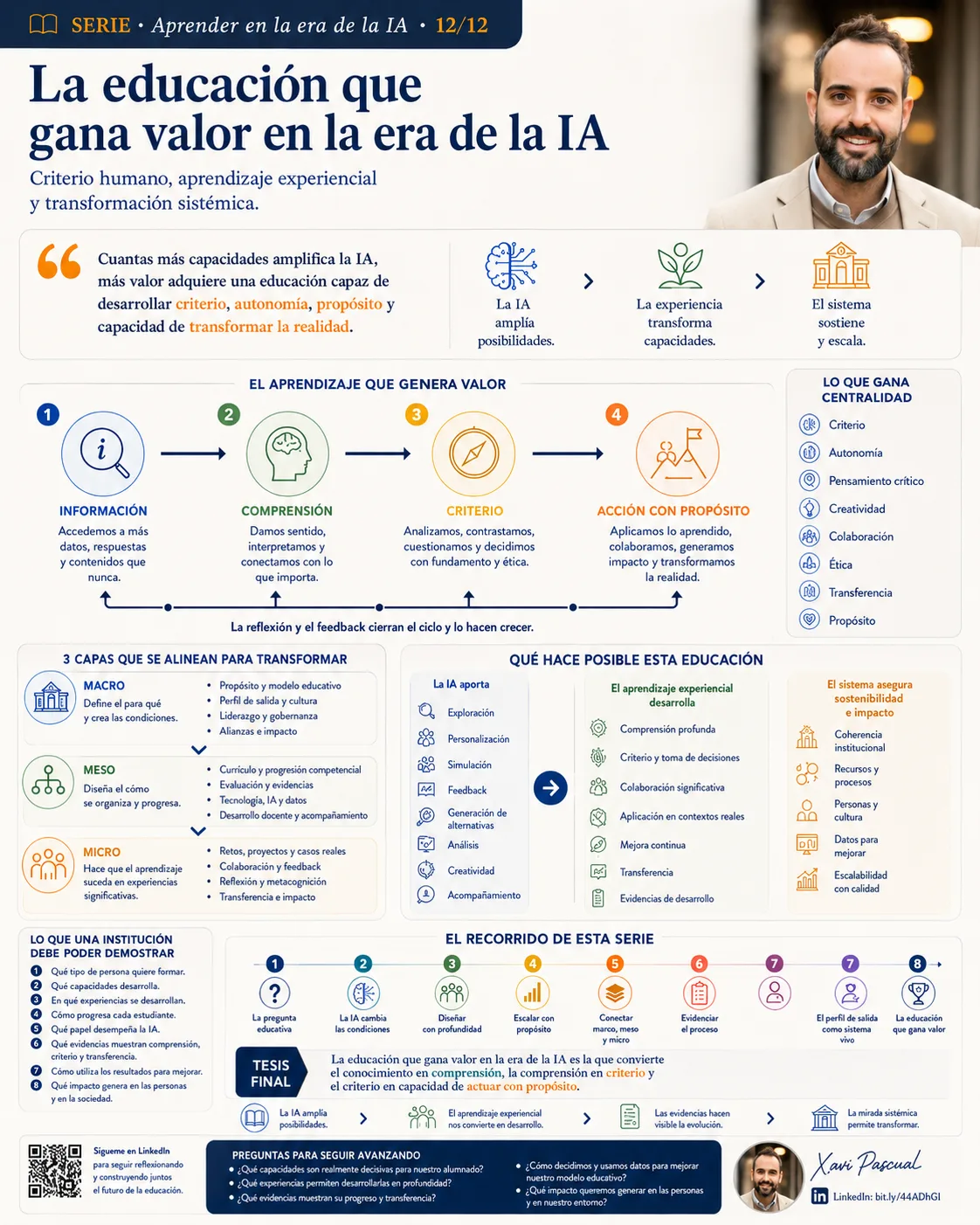
The more capabilities AI amplifies, the more value an education gains when it can develop judgment, autonomy, purpose and the capacity to transform reality.
AI expands possibilities. Experience transforms capabilities. The system sustains and scales.
The learning that generates value
A four-step cycle:
- Information — we access more data, answers and content than ever.
- Understanding — we make sense, interpret and connect with what matters.
- Judgment — we analyse, contrast, question and decide with foundations and ethics.
- Action with purpose — we apply what we learned, collaborate, generate impact and transform reality.
Reflection and feedback close the cycle and make it grow.
What becomes central: judgment, autonomy, critical thinking, creativity, collaboration, ethics, transfer and purpose.
Three layers that align to transform
- Macro — defines the why and creates the conditions: purpose and educational model, graduate profile and culture, leadership and governance, alliances and impact.
- Meso — designs the how it is organised and progresses: curriculum and competency progression, assessment and evidence, technology, AI and data, faculty development and accompaniment.
- Micro — makes learning happen in meaningful experiences: challenges, projects and real cases, collaboration and feedback, reflection and metacognition, transfer and impact.
What makes this education possible
AI contributes: exploration, personalisation, simulation, feedback, generation of alternatives, analysis, creativity, accompaniment.
Experiential learning develops: deep understanding, judgment and decision-making, meaningful collaboration, application in real contexts, continuous improvement, transfer, evidence of development.
The system ensures sustainability and impact: institutional coherence, resources and processes, people and culture, data for improvement, scalability with quality.
What an institution must be able to demonstrate
- What kind of person it wants to form
- Which capabilities it develops
- In which experiences they are developed
- How each student progresses
- What role AI plays
- Which evidence shows understanding, judgment and transfer
- How it uses results to improve
- What impact it generates on people and society
The journey of this series
The educational question → AI changes the conditions → designing with depth → scaling with purpose → connecting macro, meso and micro → evidencing the process → the graduate profile as a living system → the education that gains value.
AI expands possibilities. Experiential learning turns them into development. Evidence makes evolution visible. The systemic view makes transformation possible.
Final thesis
The education that gains value in the AI era is the one that turns knowledge into understanding, understanding into judgment, and judgment into the capacity to act with purpose.
Questions to keep moving forward
Which capabilities are truly decisive for our students? Which experiences allow developing them in depth? Which evidence shows their progress and transfer? How do we decide and use data to improve our educational model? What impact do we want to generate on people and our environment?
Back to the beginning → The series map
This reflection was originally published as an infographic on LinkedIn (in Spanish). Join the conversation on the original post or follow me on LinkedIn for the next reflections.
Learning in the AI era
See the series map →Keep exploring
Related articles
AI strategy & governance
Designing new interdisciplinary and transdisciplinary degrees: start with the profile, not the subjects
Most new degrees are designed by adding up courses from existing departments. How to design from the graduate profile and the problem the degree answers, and which organisational tensions must be resolved for it to survive.
Experiential learning
From peripheral experiential learning to the core of the educational model
Most institutions keep experiential learning at the margins: a project week, an annual challenge, an elective. What changes — across the three layers — when it becomes a structural part of the curriculum.
Education M&A
A new educational reality demands a new M&A paradigm
Education M&A still runs on the playbook of any other industry: EBITDA multiples, synergies, financial due diligence. But the asset being bought — an educational project — is mutating. What academic due diligence is, why demographics and AI break the classic playbook, and how to buy learning architectures instead of cash flows.
Shall we work on this together?
If this topic touches your institution, write to me. I reply personally, usually within 24 working hours.