AI in education did not start with ChatGPT
More than a decade of adaptive systems, learning analytics, recommendation, automated assessment and intelligent tutors. What changes with generative AI is the scale, the accessibility and the visibility of the debate.
May 25, 2026 · Xavi Pascual · 2 min read
Series Learning in the AI era · Reflection 4 of 12 · Series map
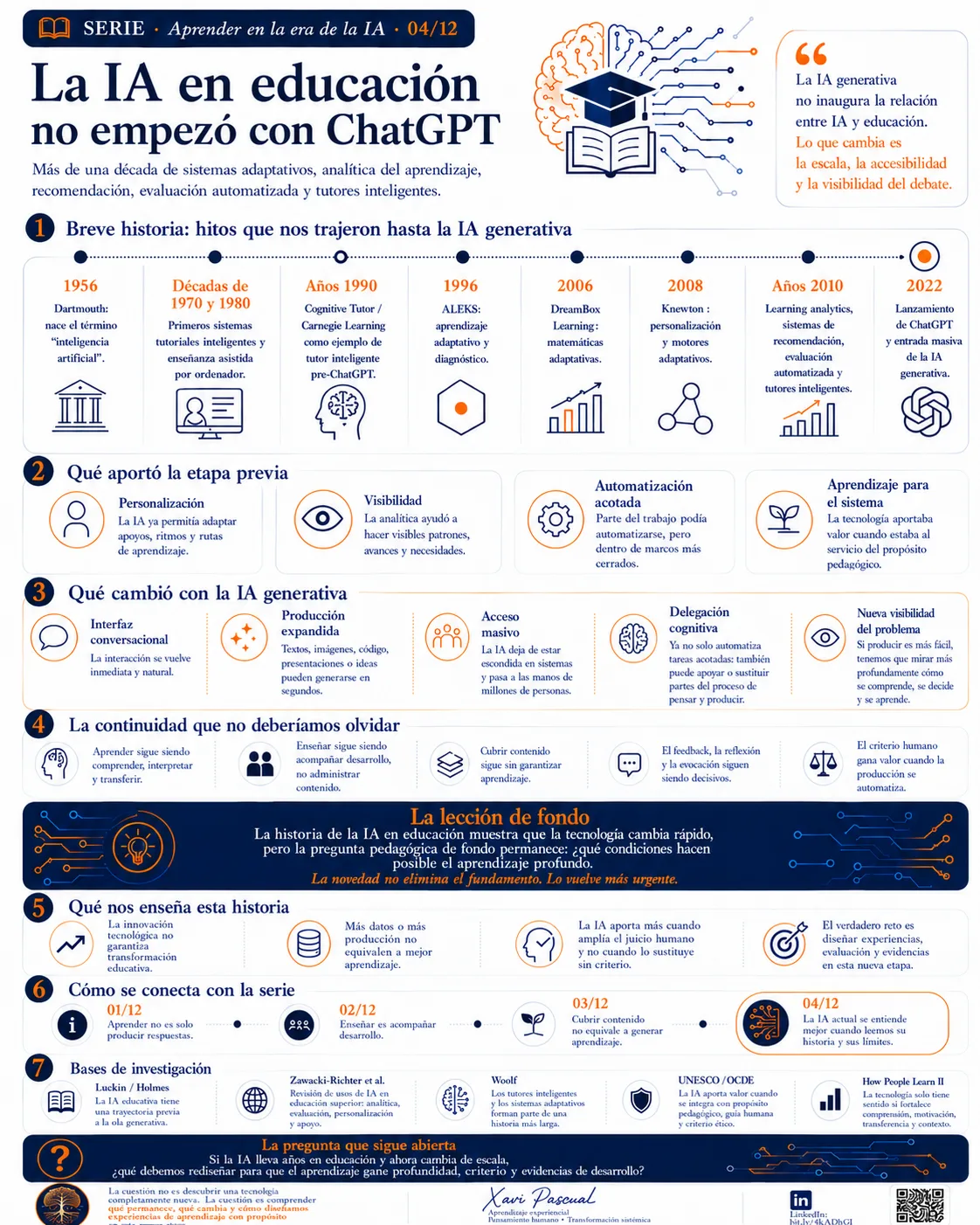
Generative AI does not inaugurate the relationship between AI and education. What changes is the scale, the accessibility and the visibility of the debate.
A brief history: the milestones that brought us here
- 1956 — Dartmouth: the term “artificial intelligence” is born.
- 1970s and 1980s — first intelligent tutoring systems and computer-assisted instruction.
- 1990s — Cognitive Tutor / Carnegie Learning as an example of a pre-ChatGPT intelligent tutor.
- 1996 — ALEKS: adaptive learning and diagnostics.
- 2006 — DreamBox Learning: adaptive mathematics.
- 2008 — Knewton: personalisation and adaptive engines.
- 2010s — learning analytics, recommendation systems, automated assessment and intelligent tutors.
- 2022 — launch of ChatGPT and the massive arrival of generative AI.
What the previous era contributed
- Personalisation — AI already allowed adapting supports, paces and learning paths.
- Visibility — analytics helped make patterns, progress and needs visible.
- Bounded automation — part of the work could be automated, but within more closed frames.
- Learning for the system — technology brought scale in service of the pedagogical purpose.
What changed with generative AI
- Conversational interface — interaction becomes immediate and natural.
- Expanded production — texts, images, code, presentations or ideas can be generated in seconds.
- Mass access — AI stops being hidden inside systems and reaches the hands of millions.
- Cognitive delegation — it no longer just automates bounded tasks: it can support or replace parts of the process of thinking and producing.
- New visibility of the problem — if producing is easier, we must look more deeply at how people understand, decide and learn.
The continuity we should not forget
Learning is still understanding, interpreting and transferring. Teaching is still accompanying development, not administering content. Covering content still does not guarantee learning. Feedback, reflection and retrieval remain decisive. And human judgment gains value when production is automated.
The underlying lesson: the history of AI in education shows that technology changes fast, but the fundamental pedagogical question remains: what conditions make deep learning possible? Novelty does not eliminate the foundation. It makes it more urgent.
This reflection draws on Luckin and Holmes, Zawacki-Richter et al., Woolf, UNESCO/OECD and How People Learn II.
The question that remains open
If AI has been in education for years and is now changing scale, what must we redesign so that learning gains depth, judgment and evidence of development?
Next reflection → When generative AI changed the scale
This reflection was originally published as an infographic on LinkedIn (in Spanish). Join the conversation on the original post or follow me on LinkedIn for the next reflections.
Learning in the AI era
See the series map →Keep exploring
Related articles
University in the AI era
Challenger universities: not every university of the future will be a transformed university
Some universities don't need to transform because they were born different. What challenger universities are, what defines them, and what a traditional university can learn from them.
University in the AI era
Learning in the AI era: the series map
12 reflections on learning, human judgment and systemic transformation in the AI era. The complete index of the series.
University in the AI era
University Learning Architecture: a framework for the AI era
Purpose → educational model → graduate profile → curriculum → experiences → assessment → evidence → impact. A macro–meso–micro framework to transform universities.
Shall we work on this together?
If this topic touches your institution, write to me. I reply personally, usually within 24 working hours.