Substitutive AI or expansive AI
The difference lies in whether the experience reduces or expands understanding, judgment and transferable learning. The same tool can produce opposite educational effects.
June 15, 2026 · Xavi Pascual · 2 min read
Series Learning in the AI era · Reflection 7 of 12 · Series map
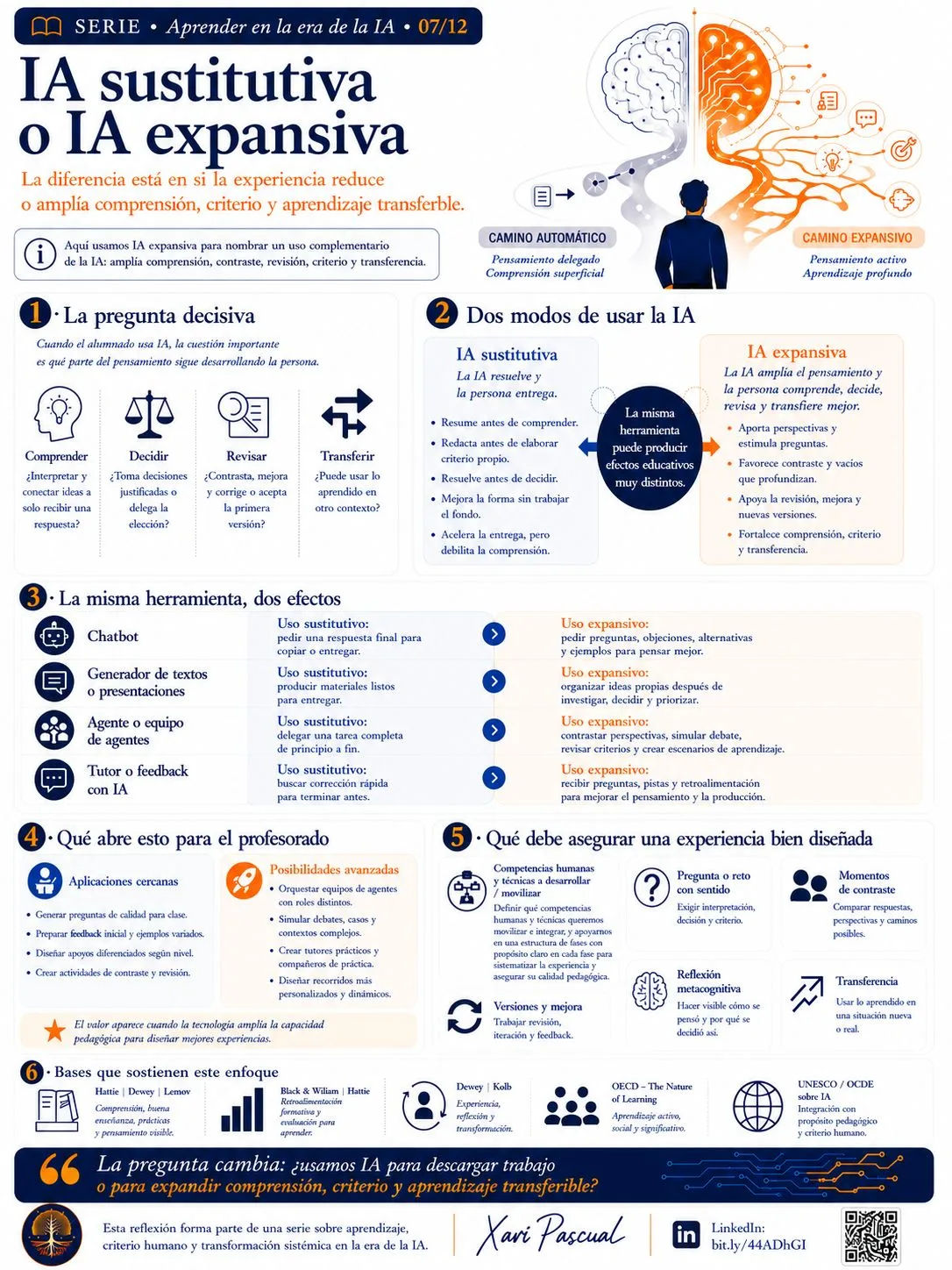
The difference is not in the tool. It is in whether the experience reduces or expands understanding, judgment and transferable learning.
The decisive question
When students use AI, the important question is which part of the thinking the person keeps developing:
- Understand — interpreting and connecting ideas, or just receiving an answer?
- Decide — taking justified decisions, or delegating the choice?
- Review — contrasting, improving and correcting, or accepting the first version?
- Transfer — can they use what they learned in another context?
Two ways of using AI
Substitutive AI: AI solves and the person submits. It summarises before understanding. It writes before own judgment is developed. It solves before deciding. It improves the form without working the substance. It accelerates delivery, but weakens understanding.
Expansive AI: AI expands thinking and the person understands, decides, reviews and transfers better. It brings perspectives and stimulates questions. It fosters contrast and gaps that deepen. It supports revision, improvement and new versions. It strengthens understanding, judgment and transfer.
The same tool can produce very different educational effects.
The same tool, two effects
- Chatbot — substitutive: asking for a final answer to copy and submit. Expansive: asking for questions, objections, alternatives and examples to think better.
- Text or presentation generator — substitutive: producing ready-to-submit materials. Expansive: organising one’s own ideas after researching, deciding and prioritising.
- Agent or team of agents — substitutive: delegating a complete task from start to finish. Expansive: contrasting perspectives, simulating debate, reviewing criteria and creating learning scenarios.
- Tutor or AI feedback — substitutive: seeking quick correction to finish sooner. Expansive: receiving questions, hints and feedback to improve thinking and production.
What a well-designed experience must ensure
- Human and technical competencies to develop — defining what we want to mobilise and integrate, with a clear purpose in each phase.
- A meaningful question or challenge — demanding interpretation, decision and judgment.
- Moments of contrast — comparing answers, perspectives and possible paths.
- Versions and improvement — working revision, iteration and feedback.
- Metacognitive reflection — making visible how it was thought and why it was decided that way.
- Transfer — using what was learned in a new or real situation.
This approach draws on Hattie, Dewey, Lemov, Black & Wiliam, Kolb, OECD — The Nature of Learning and UNESCO/OECD guidance on AI.
The question changes
Do we use AI to offload work, or to expand understanding, judgment and transferable learning?
Next reflection → Scaling experiential learning with purpose, sustainability and foundations
This reflection was originally published as an infographic on LinkedIn (in Spanish). Join the conversation on the original post or follow me on LinkedIn for the next reflections.
Learning in the AI era
See the series map →Keep exploring
Related articles
University in the AI era
Challenger universities: not every university of the future will be a transformed university
Some universities don't need to transform because they were born different. What challenger universities are, what defines them, and what a traditional university can learn from them.
University in the AI era
Learning in the AI era: the series map
12 reflections on learning, human judgment and systemic transformation in the AI era. The complete index of the series.
University in the AI era
University Learning Architecture: a framework for the AI era
Purpose → educational model → graduate profile → curriculum → experiences → assessment → evidence → impact. A macro–meso–micro framework to transform universities.
Shall we work on this together?
If this topic touches your institution, write to me. I reply personally, usually within 24 working hours.