AI agents: when execution is automated, judgment becomes central
As AI makes execution easier, educational value shifts towards intention, judgment, orchestration, feedback and evidence of learning.
June 8, 2026 · Xavi Pascual · 2 min read
Series Learning in the AI era · Reflection 6 of 12 · Series map
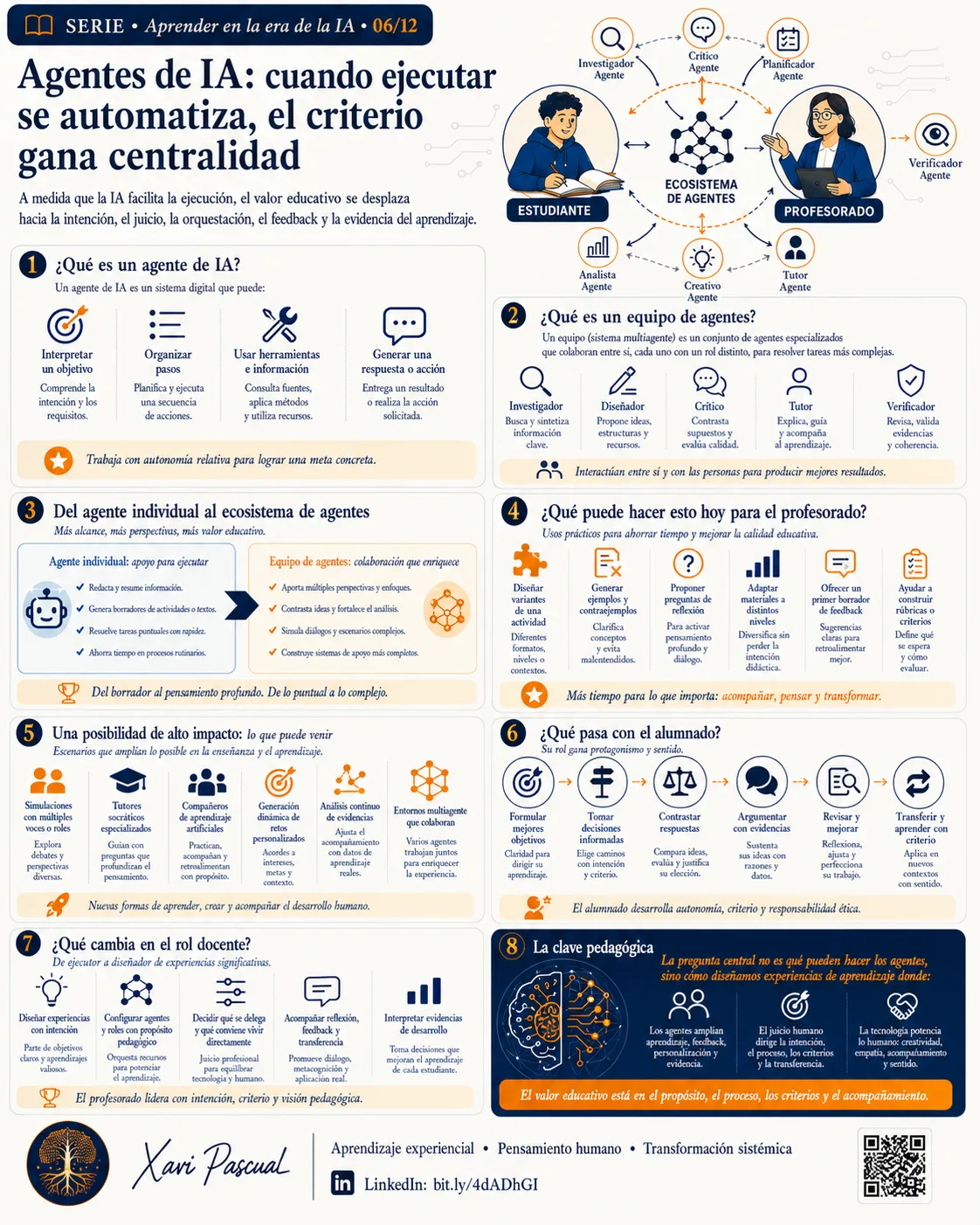
As AI makes execution easier, educational value shifts towards intention, judgment, orchestration, feedback and evidence of learning.
What is an AI agent?
An AI agent is a digital system that can interpret a goal, organise steps, use tools and information, and generate a response or action. It works with relative autonomy to achieve a concrete goal.
A team of agents (multi-agent system) is a set of specialised agents that collaborate, each with a different role, to solve more complex tasks: researcher, designer, critic, tutor, verifier.
From the individual agent to the agent ecosystem
The individual agent supports execution: it drafts and summarises information, generates drafts of activities and texts, solves discrete tasks quickly, saves time on routine processes.
The team of agents brings enriching collaboration: multiple perspectives and approaches, contrast of ideas and stronger analysis, simulation of complex dialogues and scenarios, more complete support systems.
From the draft to deep thinking. From the discrete to the complex.
What can this do for faculty today?
Design variants of an activity, generate examples and counterexamples, propose reflection questions, adapt materials to different levels, offer a first draft of feedback, help build rubrics or criteria. More time for what matters: accompanying, thinking and transforming.
What about students?
Their role gains protagonism and meaning: formulating better objectives, taking informed decisions, contrasting answers, arguing with evidence, reviewing and improving, transferring and learning with judgment. Students develop autonomy, judgment and ethical responsibility.
What changes in the teaching role?
From executing to designing meaningful experiences: designing experiences with intention, configuring agents and roles with pedagogical purpose, deciding what is delegated and what should be lived directly, accompanying reflection, feedback and transfer, interpreting evidence of development.
Faculty lead with intention, judgment and pedagogical vision.
The pedagogical key
The central question is not what agents can do, but how we design learning experiences where:
- Agents expand learning, feedback and possibilities
- Human judgment directs the intention, the process, the criteria and the transfer
- Technology amplifies the human: creativity, accompaniment and meaning
Educational value lies in the purpose, the process, the criteria and the accompaniment.
Next reflection → Substitutive AI or expansive AI
This reflection was originally published as an infographic on LinkedIn (in Spanish). Join the conversation on the original post or follow me on LinkedIn for the next reflections.
Learning in the AI era
See the series map →Keep exploring
Related articles
University in the AI era
Challenger universities: not every university of the future will be a transformed university
Some universities don't need to transform because they were born different. What challenger universities are, what defines them, and what a traditional university can learn from them.
University in the AI era
Learning in the AI era: the series map
12 reflections on learning, human judgment and systemic transformation in the AI era. The complete index of the series.
University in the AI era
University Learning Architecture: a framework for the AI era
Purpose → educational model → graduate profile → curriculum → experiences → assessment → evidence → impact. A macro–meso–micro framework to transform universities.
Shall we work on this together?
If this topic touches your institution, write to me. I reply personally, usually within 24 working hours.