Scaling experiential learning with purpose, sustainability and foundations
Moving from isolated experiences to systems that sustain deep learning. The great opportunity is not doing more experiences: it is getting more people to live experiences that truly transform.
June 22, 2026 · Xavi Pascual · 2 min read
Series Learning in the AI era · Reflection 8 of 12 · Series map
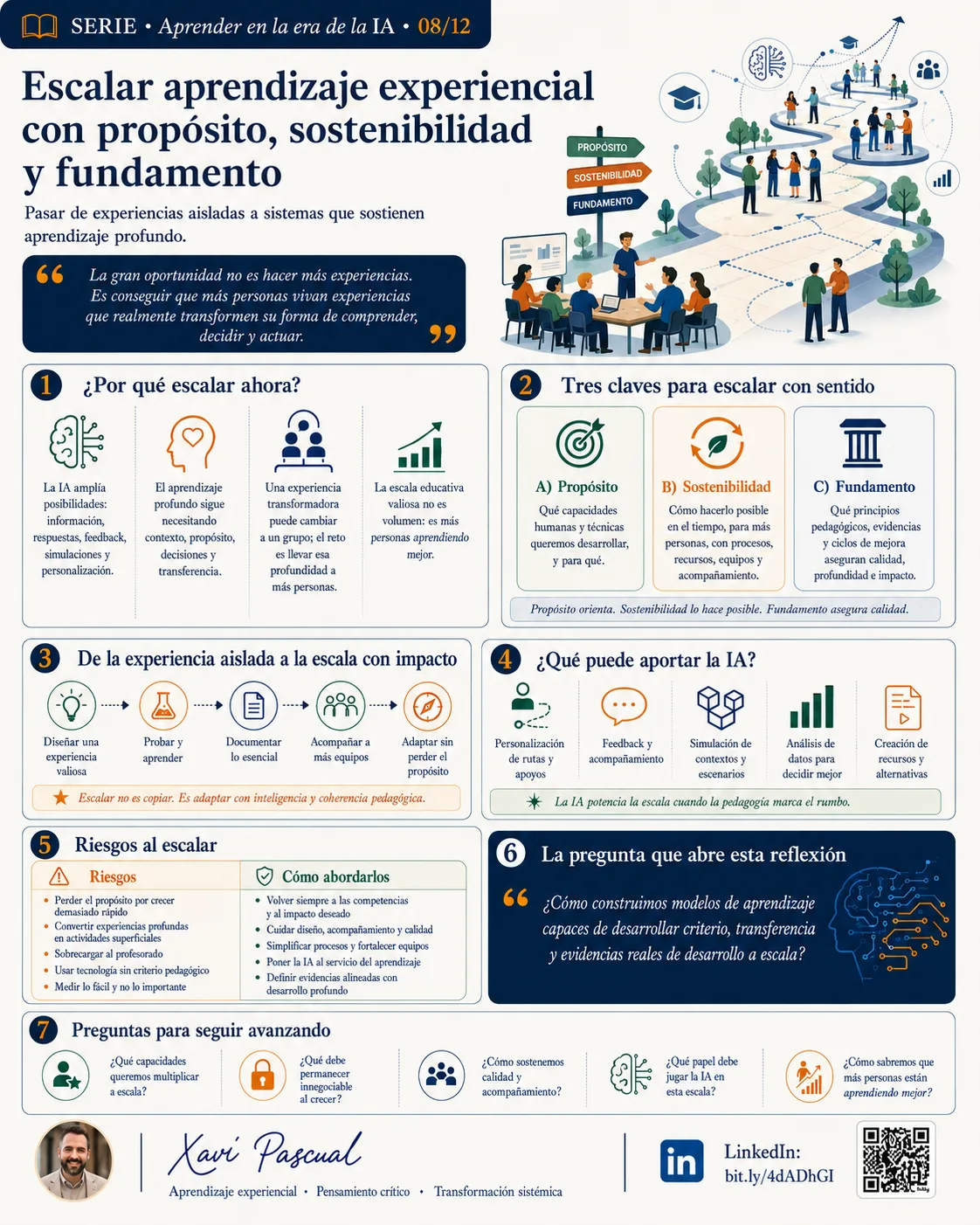
The great opportunity is not doing more experiences. It is getting more people to live experiences that truly transform the way they understand, decide and act.
Why scale now?
- AI expands possibilities: information, answers, feedback, simulations and personalisation
- Deep learning still needs context, purpose, decisions and transfer
- A transformative experience can change one group; the challenge is bringing that depth to more people
- Valuable educational scale is not volume: it is more people learning better
Three keys to scaling with meaning
- Purpose — which human and technical capabilities we want to develop, and what for.
- Sustainability — how to make it possible over time, for more people, with processes, resources, teams and accompaniment.
- Foundations — which pedagogical principles, evidence and improvement cycles ensure quality, depth and impact.
Purpose orients. Sustainability makes it possible. Foundations ensure quality.
From the isolated experience to scale with impact
Design a valuable experience → test and learn → document the essentials → accompany more teams → adapt without losing the purpose.
Scaling is not copying. It is adapting with intelligence and pedagogical coherence.
What can AI contribute?
Personalisation of paths and supports, feedback and accompaniment, simulation of contexts and scenarios, data analysis for better decisions, creation of resources and alternatives. AI amplifies scale when pedagogy sets the course.
Risks when scaling — and how to address them
Risks: losing the purpose by growing too fast; turning deep experiences into superficial activities; overloading faculty; using technology without pedagogical judgment; measuring what is easy rather than what matters.
How to address them: always return to the competencies and the desired impact; take care of design, accompaniment and quality; simplify processes and strengthen teams; put AI at the service of learning; define evidence aligned with deep development.
The question this reflection opens
How do we build learning models capable of developing judgment, transfer and real evidence of development at scale?
Questions to keep moving forward: which capabilities do we want to multiply at scale? What must remain non-negotiable as we grow? How do we sustain quality and accompaniment? What role should AI play in this scale? How will we know more people are learning better?
Next reflection → Macro, meso and micro: three layers to transform learning
This reflection was originally published as an infographic on LinkedIn (in Spanish). Join the conversation on the original post or follow me on LinkedIn for the next reflections.
Learning in the AI era
See the series map →Keep exploring
Related articles
Experiential learning
From peripheral experiential learning to the core of the educational model
Most institutions keep experiential learning at the margins: a project week, an annual challenge, an elective. What changes — across the three layers — when it becomes a structural part of the curriculum.
AI strategy & governance
Designing new interdisciplinary and transdisciplinary degrees: start with the profile, not the subjects
Most new degrees are designed by adding up courses from existing departments. How to design from the graduate profile and the problem the degree answers, and which organisational tensions must be resolved for it to survive.
Education M&A
A new educational reality demands a new M&A paradigm
Education M&A still runs on the playbook of any other industry: EBITDA multiples, synergies, financial due diligence. But the asset being bought — an educational project — is mutating. What academic due diligence is, why demographics and AI break the classic playbook, and how to buy learning architectures instead of cash flows.
Shall we work on this together?
If this topic touches your institution, write to me. I reply personally, usually within 24 working hours.