The first crack: teaching was always much more than covering a syllabus
The origin of an educational unease: accompanying development, not administering content. Before, teaching meant covering. Today, teaching means helping people grow.
May 11, 2026 · Xavi Pascual · 3 min read
Series Learning in the AI era · Reflection 2 of 12 · Series map
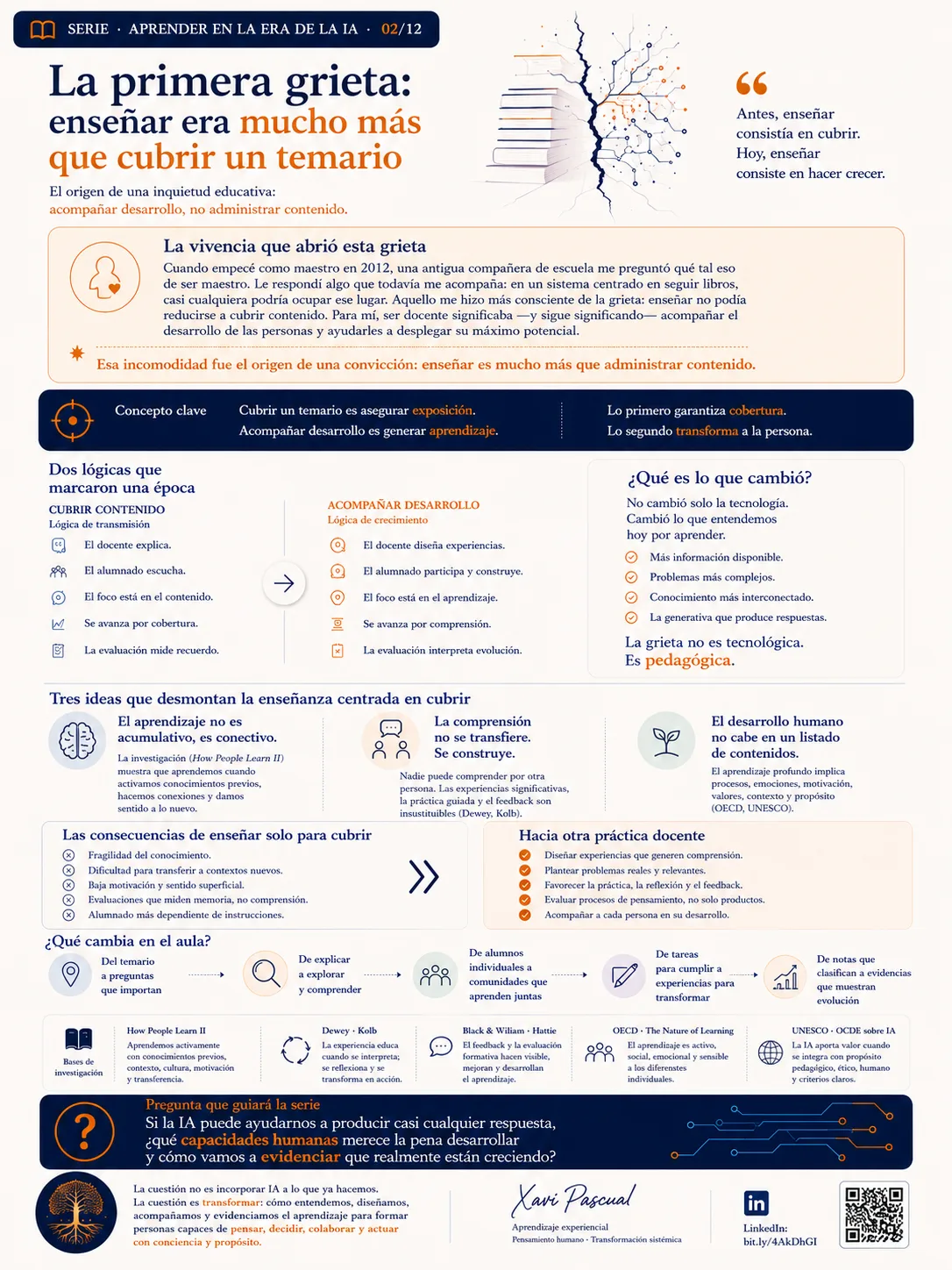
Before, teaching meant covering. Today, teaching means helping people grow.
The experience that opened this crack
When I started as a schoolteacher in 2012, a former school classmate asked me what it was like to be a teacher. I answered something that still stays with me: in a system centred on following textbooks, almost anyone could fill that role.
That made me more aware of the crack: teaching could not be reduced to covering content. For me, being an educator meant — and still means — accompanying people’s development and helping them unfold their full potential.
That discomfort was the origin of a conviction: teaching is much more than administering content.
Key concept
Covering a syllabus ensures exposure. Accompanying development generates learning. The first guarantees coverage. The second transforms the person.
Two logics that defined an era
Covering content (transmission logic):
- The teacher explains
- Students listen
- The focus is on the content
- Progress is measured by coverage
- Assessment measures recall
Accompanying development (growth logic):
- The teacher designs experiences
- Students participate and construct
- The focus is on learning
- Progress is measured by understanding
- Assessment interprets evolution
What actually changed?
It was not just the technology. What we understand by learning changed: more information available, more complex problems, more interconnected knowledge, generative AI producing answers.
The crack is not technological. It is pedagogical.
Three ideas that dismantle coverage-centred teaching
- Learning is not cumulative, it is connective. Research (How People Learn II) shows we learn by activating prior knowledge, making connections and giving meaning to the new.
- Understanding is not transferred. It is constructed. Nobody can understand for another person. Meaningful experiences, guided practice and feedback are irreplaceable (Dewey, Kolb).
- Human development does not fit in a list of contents. Deep learning involves processes, emotions, motivation, values, context and purpose (OECD, UNESCO).
The consequences of teaching only to cover
Fragile knowledge, difficulty transferring to new contexts, low motivation and superficial meaning, assessments that measure memory rather than understanding, students more dependent on instructions.
Towards another teaching practice
- Design experiences that generate understanding
- Pose real, relevant problems
- Foster practice, reflection and feedback
- Assess thinking processes, not just products
- Accompany each person in their development
What changes in the classroom?
From the syllabus to questions that matter. From explaining to exploring and understanding. From individual students to communities that learn together. From tasks to complete to experiences that transform. From grades that classify to evidence that shows evolution.
This reflection draws on How People Learn II, Dewey and Kolb, Black & Wiliam and Hattie, OECD — The Nature of Learning and UNESCO/OECD on AI.
The question that will guide the series
If AI can help us produce almost any answer, which human capabilities are worth developing, and how will we evidence that they are actually growing?
The point is not adding AI to what we already do. The point is transforming how we understand, design, accompany and evidence learning to form people capable of thinking, deciding, collaborating and acting with awareness and purpose.
Next reflection → Covering content is not the same as generating learning
This reflection was originally published as an infographic on LinkedIn (in Spanish). Join the conversation on the original post or follow me on LinkedIn for the next reflections.
Learning in the AI era
See the series map →Keep exploring
Related articles
Experiential learning
From peripheral experiential learning to the core of the educational model
Most institutions keep experiential learning at the margins: a project week, an annual challenge, an elective. What changes — across the three layers — when it becomes a structural part of the curriculum.
AI strategy & governance
Designing new interdisciplinary and transdisciplinary degrees: start with the profile, not the subjects
Most new degrees are designed by adding up courses from existing departments. How to design from the graduate profile and the problem the degree answers, and which organisational tensions must be resolved for it to survive.
Education M&A
A new educational reality demands a new M&A paradigm
Education M&A still runs on the playbook of any other industry: EBITDA multiples, synergies, financial due diligence. But the asset being bought — an educational project — is mutating. What academic due diligence is, why demographics and AI break the classic playbook, and how to buy learning architectures instead of cash flows.
Shall we work on this together?
If this topic touches your institution, write to me. I reply personally, usually within 24 working hours.