Covering content is not the same as generating learning
An institution can cover an entire syllabus and still not have created the conditions for learning to happen with depth. What learning needs in order to occur.
May 18, 2026 · Xavi Pascual · 2 min read
Series Learning in the AI era · Reflection 3 of 12 · Series map
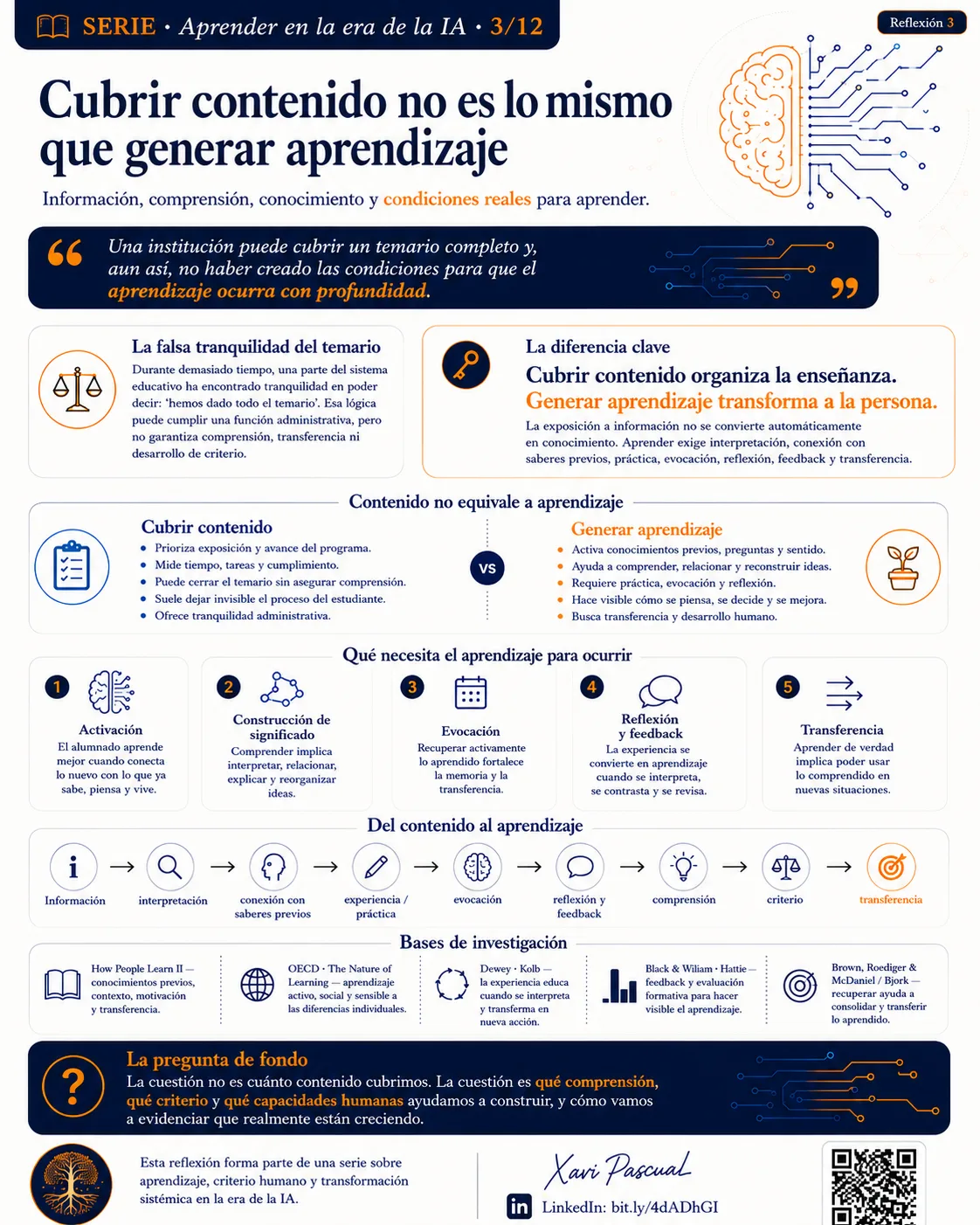
An institution can cover an entire syllabus and still not have created the conditions for learning to happen with depth.
The false comfort of the syllabus
For too long, part of the education system has found comfort in being able to say: “we covered the whole syllabus”. That logic may fulfil an administrative function, but it guarantees neither understanding, nor transfer, nor the development of judgment.
The key difference: covering content organises teaching; generating learning transforms the person. Exposure to information does not automatically become knowledge. Learning demands interpretation, connection with prior knowledge, practice, retrieval, reflection, feedback and transfer.
Content does not equal learning
Covering content:
- Prioritises exposition and programme progress
- Measures time, tasks and compliance
- Can close the syllabus without ensuring understanding
- Usually leaves the student’s process invisible
- Offers administrative reassurance
Generating learning:
- Activates prior knowledge, questions and meaning
- Helps understand, relate and reconstruct ideas
- Requires practice, retrieval and reflection
- Makes visible how people think, decide and improve
- Seeks transfer and human development
What learning needs in order to occur
- Activation — students learn best when they connect the new with what they already know, think and live.
- Meaning construction — understanding means interpreting, relating, explaining and reorganising ideas.
- Retrieval — actively recalling what was learned strengthens memory and transfer.
- Reflection and feedback — experience becomes learning when it is interpreted, contrasted and reviewed.
- Transfer — truly learning means being able to use what was understood in new situations.
The full journey runs from information to transfer, passing through interpretation, connection with prior knowledge, experience and practice, retrieval, reflection and feedback, understanding and judgment.
This reflection draws on How People Learn II, OECD — The Nature of Learning, Dewey and Kolb, Black & Wiliam and Hattie, and Brown, Roediger & McDaniel on retrieval practice.
The underlying question
The question is not how much content we cover. The question is which understanding, which judgment and which human capabilities we help build, and how we will evidence that they are actually growing.
Next reflection → AI in education did not start with ChatGPT
This reflection was originally published as an infographic on LinkedIn (in Spanish). Join the conversation on the original post or follow me on LinkedIn for the next reflections.
Learning in the AI era
See the series map →Keep exploring
Related articles
Experiential learning
From peripheral experiential learning to the core of the educational model
Most institutions keep experiential learning at the margins: a project week, an annual challenge, an elective. What changes — across the three layers — when it becomes a structural part of the curriculum.
AI strategy & governance
Designing new interdisciplinary and transdisciplinary degrees: start with the profile, not the subjects
Most new degrees are designed by adding up courses from existing departments. How to design from the graduate profile and the problem the degree answers, and which organisational tensions must be resolved for it to survive.
Education M&A
A new educational reality demands a new M&A paradigm
Education M&A still runs on the playbook of any other industry: EBITDA multiples, synergies, financial due diligence. But the asset being bought — an educational project — is mutating. What academic due diligence is, why demographics and AI break the classic playbook, and how to buy learning architectures instead of cash flows.
Shall we work on this together?
If this topic touches your institution, write to me. I reply personally, usually within 24 working hours.