When generative AI changed the scale
What used to require hours or days of work can now be generated in seconds. That new scale transforms what we observe, assess and value. The illusion of understanding is the great educational challenge.
June 1, 2026 · Xavi Pascual · 2 min read
Series Learning in the AI era · Reflection 5 of 12 · Series map
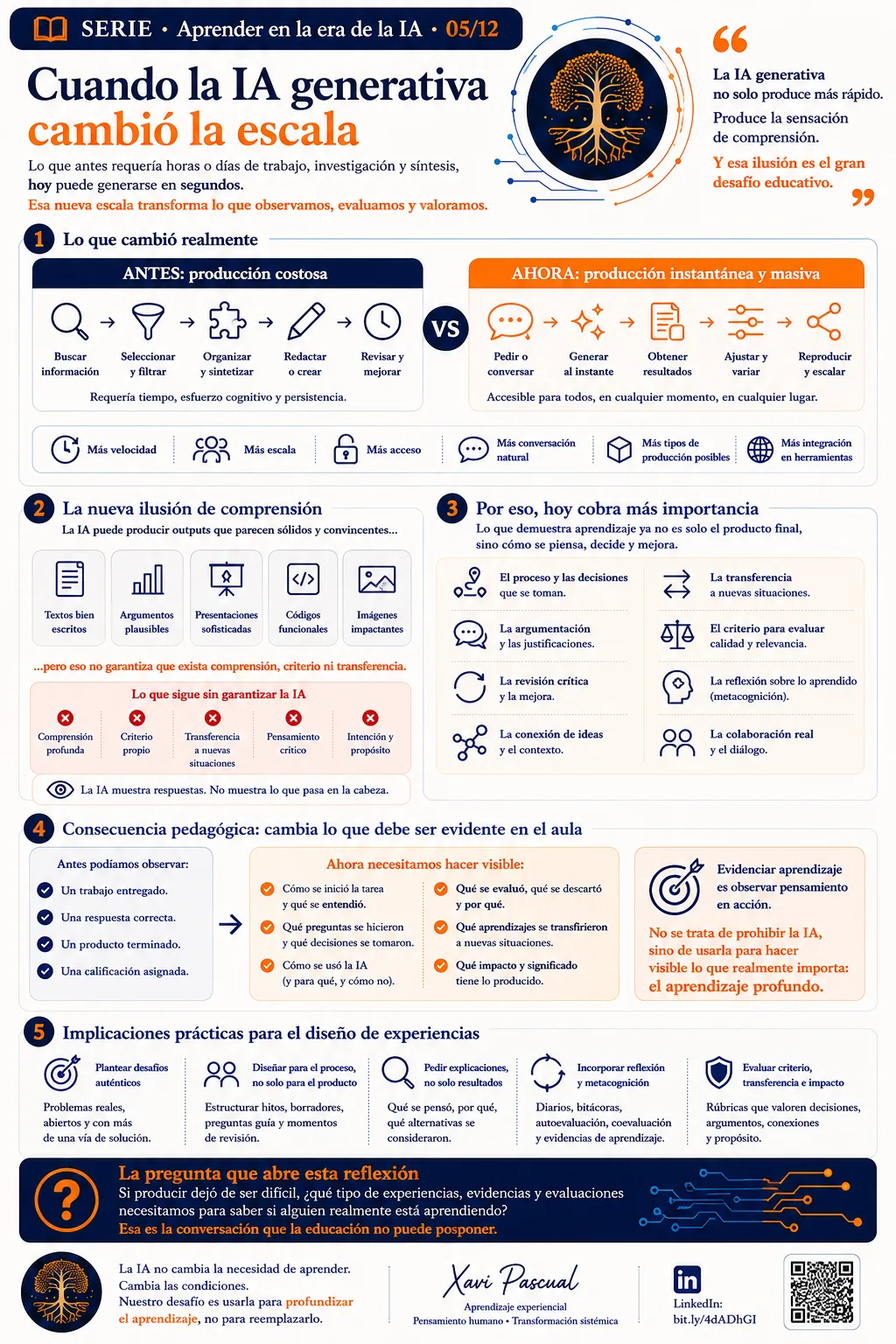
Generative AI does not just produce faster. It produces the sensation of understanding. And that illusion is the great educational challenge.
What really changed
Before, producing was costly: searching for information, selecting and filtering, organising and synthesising, writing or creating, reviewing and improving. It required time, cognitive effort and persistence.
Now, production is instant and massive: ask or converse, generate instantly, obtain results, adjust and vary, reproduce and scale. Accessible to everyone, at any time, anywhere.
The new illusion of understanding
AI can produce outputs that look solid and convincing: well-written texts, plausible arguments, sophisticated presentations, functional code, striking images.
But that does not guarantee understanding, judgment or transfer. What AI still does not guarantee: deep understanding, own judgment, transfer to new situations, critical thinking, intention and purpose.
AI shows answers. It does not show what happens inside the head.
That is why these things matter more today
What demonstrates learning is no longer just the final product, but:
- The process and the decisions taken
- The argumentation and the justifications
- Critical review and improvement
- The connection of ideas and context
- Transfer to new situations
- The judgment to evaluate quality and relevance
- Reflection on what was learned (metacognition)
- Real collaboration and dialogue
Pedagogical consequence: what must be evident in the classroom changes
Before, we could observe a submitted assignment, a correct answer, a finished product, an assigned grade. Now we need to make visible: how the task was started and what was understood, which questions were asked and which decisions were taken, how AI was used (and for what), what was evaluated, what was discarded and why, which learning was transferred.
It is not about banning AI, but about using it to make visible what really matters: deep learning.
Practical implications for experience design
- Pose authentic challenges — real, open problems with more than one path to a solution.
- Design for the process, not just the product — structure milestones, drafts, guiding questions and review moments.
- Ask for explanations, not just results — what was thought, why, which alternatives were considered.
- Incorporate reflection and metacognition — journals, logs, self-assessment, peer assessment and evidence of learning.
- Assess judgment, transfer and impact — rubrics that value decisions, arguments, connections and purpose.
The question this reflection opens
If producing stopped being hard, what kind of experiences, evidence and assessment do we need to know whether someone is actually learning? That is the conversation education cannot postpone.
Next reflection → AI agents: when execution is automated, judgment becomes central
This reflection was originally published as an infographic on LinkedIn (in Spanish). Join the conversation on the original post or follow me on LinkedIn for the next reflections.
Learning in the AI era
See the series map →Keep exploring
Related articles
University in the AI era
Challenger universities: not every university of the future will be a transformed university
Some universities don't need to transform because they were born different. What challenger universities are, what defines them, and what a traditional university can learn from them.
University in the AI era
Learning in the AI era: the series map
12 reflections on learning, human judgment and systemic transformation in the AI era. The complete index of the series.
University in the AI era
University Learning Architecture: a framework for the AI era
Purpose → educational model → graduate profile → curriculum → experiences → assessment → evidence → impact. A macro–meso–micro framework to transform universities.
Shall we work on this together?
If this topic touches your institution, write to me. I reply personally, usually within 24 working hours.