The graduate profile as a living system
The graduate profile comes alive when it guides what is designed, what is accompanied, what is assessed and what an institution is able to evidence. Five connected dimensions.
July 13, 2026 · Xavi Pascual · 2 min read
Series Learning in the AI era · Reflection 11 of 12 · Series map
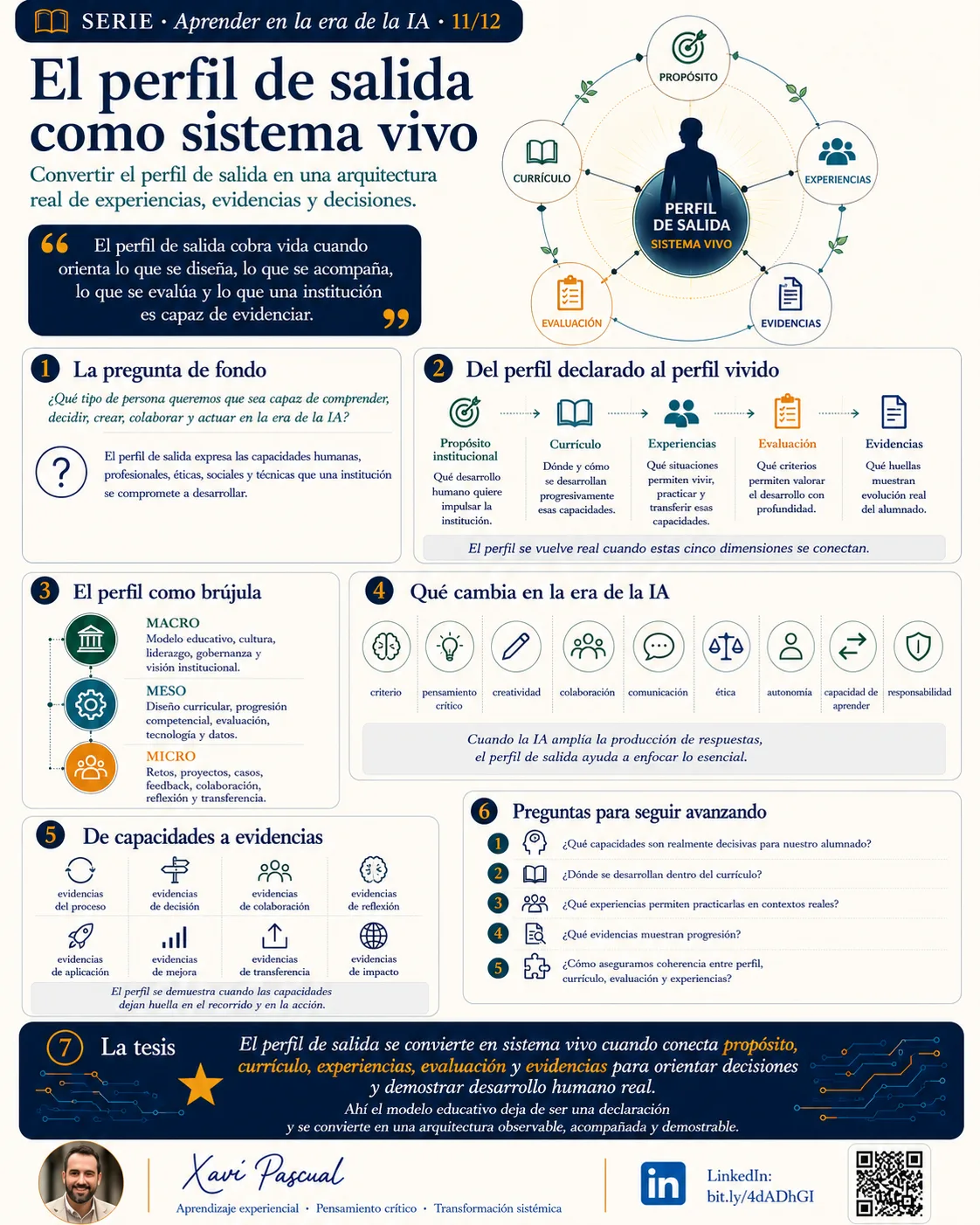
The graduate profile comes alive when it guides what is designed, what is accompanied, what is assessed and what an institution is able to evidence.
The underlying question
What kind of person do we want to be capable of understanding, deciding, creating, collaborating and acting in the AI era?
The graduate profile expresses the human, professional, ethical, social and technical capabilities an institution commits to developing.
From the declared profile to the lived profile
Five dimensions that must connect:
- Institutional purpose — what human development the institution wants to drive.
- Curriculum — where and how those capabilities are progressively developed.
- Experiences — which situations allow those capabilities to be lived, practised and transferred.
- Assessment — which criteria allow development to be valued with depth.
- Evidence — which traces show real evolution of the students.
The profile becomes real when these five dimensions connect.
The profile as a compass
- Macro — educational model, culture, leadership, governance and institutional vision.
- Meso — curricular design, competency progression, assessment, technology and data.
- Micro — challenges, projects, cases, feedback, collaboration, reflection and transfer.
It is the link connecting the three layers of the previous reflection with each student’s development.
What changes in the AI era
When AI expands the production of answers, the graduate profile helps focus on the essential: judgment, critical thinking, creativity, collaboration, communication, ethics, autonomy, the capacity to learn and responsibility.
From capabilities to evidence
The profile is demonstrated when capabilities leave traces along the journey and in action: evidence of process, of decision, of collaboration, of reflection, of application, of improvement, of transfer and of impact.
Questions to keep moving forward
- Which capabilities are truly decisive for our students?
- Where are they developed within the curriculum?
- Which experiences allow practising them in real contexts?
- Which evidence shows progression?
- How do we ensure coherence between profile, curriculum, assessment and experiences?
The thesis
The graduate profile becomes a living system when it connects purpose, curriculum, experiences, assessment and evidence to guide decisions and demonstrate real human development. There, the educational model stops being a declaration and becomes an observable, accompanied and demonstrable architecture.
I develop the employability dimension of this topic in Which capabilities should a person develop when AI can answer?
Next reflection → The education that gains value in the AI era
This reflection was originally published as an infographic on LinkedIn (in Spanish). Join the conversation on the original post or follow me on LinkedIn for the next reflections.
Learning in the AI era
See the series map →Keep exploring
Related articles
Capabilities & employability
What capabilities must a person develop when AI can answer?
The human graduate profile in the AI era: technological and human capabilities, competency progression and evidence connected to employability.
AI strategy & governance
Designing new interdisciplinary and transdisciplinary degrees: start with the profile, not the subjects
Most new degrees are designed by adding up courses from existing departments. How to design from the graduate profile and the problem the degree answers, and which organisational tensions must be resolved for it to survive.
Experiential learning
From peripheral experiential learning to the core of the educational model
Most institutions keep experiential learning at the margins: a project week, an annual challenge, an elective. What changes — across the three layers — when it becomes a structural part of the curriculum.
Shall we work on this together?
If this topic touches your institution, write to me. I reply personally, usually within 24 working hours.